
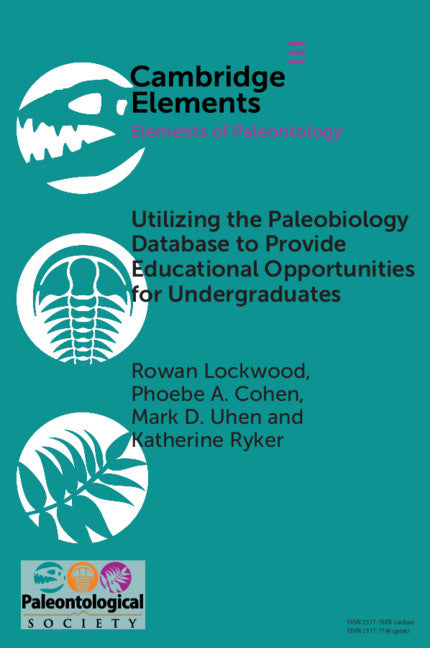
Utilizing the Paleobiology Database to Provide Educational Opportunities for Undergraduates
Author(s): Rowan Lockwood , Phoebe A. Cohen , Mark D. Uhen , Katherine Ryker
Quantity
Pickup available at Cambridge University Press Bookshop
Usually ready in 24 hours
Utilizing the Paleobiology Database to Provide Educational Opportunities for Undergraduates
Cambridge University Press Bookshop
1-2 Trinity Street
Cambridge CB2 1SZ
United Kingdom
🚚 Please note we can only ship within the UK.
FREE delivery on books (excluding sale).
Delivery for other items is £1.50 - £4.50, calculated at checkout.
T&Cs apply.
Free click & collect on all orders.
Integration of research experiences into the undergraduate classroom can result in increased recruitment, retention, and motivation of science students. 'Big data' science initiatives, such as the Paleobiology Database (PBDB), can provide inexpensive and accessible research opportunities. This Element provides an introduction to what the PBDB is, how to use it, how it can be deployed in introductory and advanced courses, and examples of how it has been used in undergraduate research. The PBDB aims to provide information on all fossil organisms, across the tree of life, around the world, and through all of geologic time. The PBDB Resource Page contains a range of PBDB tutorials and activities for use in physical geology, historical geology, paleontology, sedimentology, and stratigraphy courses. As two-year colleges, universities, and distance-based learning initiatives seek research-based alternatives to traditional lab exercises, the PBDB can provide opportunities for hands-on science activities.

Choose options