
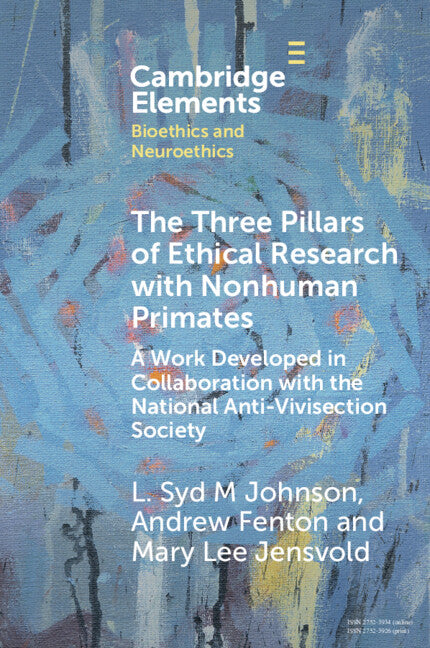
The Three Pillars of Ethical Research with Nonhuman Primates
A Work Developed in Collaboration with the National Anti-Vivisection Society
Author(s): L. Syd M Johnson , Andrew Fenton , Mary Lee Jensvold
Quantity
Pickup available at Cambridge University Press Bookshop
Usually ready in 24 hours
The Three Pillars of Ethical Research with Nonhuman Primates
Cambridge University Press Bookshop
1-2 Trinity Street
Cambridge CB2 1SZ
United Kingdom
🚚 Please note we can only ship within the UK.
FREE delivery on books (excluding sale).
Delivery for other items is £1.50 - £4.50, calculated at checkout.
T&Cs apply.
Free click & collect on all orders.
The Three Pillars (Harmonization, Replacement, and Justice) describe an ethical path forward and away from the use of nonhuman primates in harmful research and scientific use. Conducting nonhuman primate research in an ethical way that acknowledges their moral importance requires satisfying more rigorous guidelines and regulations modeled on those that apply to similarly vulnerable human subjects, especially children and incarcerated persons. This Element argues for the moral necessity of harmonizing human and nonhuman primate research ethics, regulations, and guidelines in a way that protects all primates, human and nonhuman. The authors call for the replacement of nonhuman primates in research with human-relevant methods that do not simply shift research onto other nonhuman animals, and challenge publics, governments, and scientific communities worldwide to implement justice in the selection and use of all research subjects. This title is also available as Open Access on Cambridge Core.
%20describe%20an%20ethical%20path%20forward%20and%20away%20from%20the%20use%20of%20nonhuman%20primates%20in%20harmful%20research%20and%20scientific%20use.%20Conducting%20nonhuman%20p...)
Choose options