
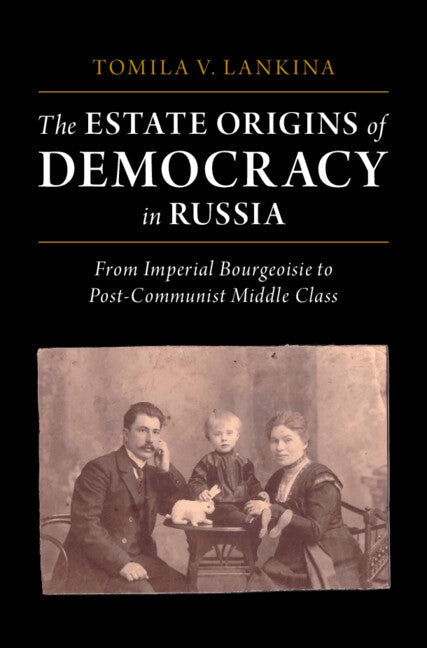
The Estate Origins of Democracy in Russia
From Imperial Bourgeoisie to Post-Communist Middle Class
Author(s): Tomila V. Lankina
Quantity
Pickup available at Cambridge University Press Bookshop
Usually ready in 24 hours
The Estate Origins of Democracy in Russia
Cambridge University Press Bookshop
Pickup available, Usually ready in 24 hours
1-2 Trinity Street
Cambridge CB2 1SZ
United Kingdom
🚚 Please note we can only ship within the UK.
FREE delivery on books (excluding sale).
Delivery for other items is £1.50 - £4.50, calculated at checkout.
T&Cs apply.
Free click & collect on all orders.
A devastating challenge to the idea of communism as a 'great leveller', this extraordinarily original, rigorous, and ambitious book debunks Marxism-inspired accounts of its equalitarian consequences. It is the first study systematically to link the genesis of the 'bourgeoisie-cum-middle class' – Imperial, Soviet, and post-communist – to Tzarist estate institutions which distinguished between nobility, clergy, the urban merchants and meshchane, and peasants. It demonstrates how the pre-communist bourgeoisie, particularly the merchant and urban commercial strata but also the high human capital aristocracy and clergy, survived and adapted in Soviet Russia. Under both Tzarism and communism, the estate system engendered an educated, autonomous bourgeoisie and professional class, along with an oppositional public sphere, and persistent social cleavages that continue to plague democratic consensus. This book also shows how the middle class, conventionally bracketed under one generic umbrella, is often two-pronged in nature – one originating among the educated estates of feudal orders, and the other fabricated as part of state-induced modernization.

Choose options
The Estate Origins of Democracy in Russia
Sale price£38.00 GBP