
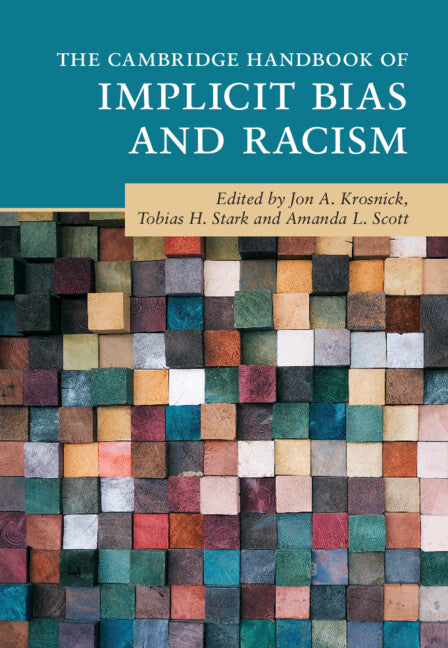
The Cambridge Handbook of Implicit Bias and Racism
Author(s): Edited by Jon A. Krosnick, Tobias H. Stark, Amanda L. Scott
Quantity
Pickup available at Cambridge University Press Bookshop
Usually ready in 24 hours
The Cambridge Handbook of Implicit Bias and Racism
Cambridge University Press Bookshop
1-2 Trinity Street
Cambridge CB2 1SZ
United Kingdom
🚚 Please note we can only ship within the UK.
FREE delivery on books (excluding sale).
Delivery for other items is £1.50 - £4.50, calculated at checkout.
T&Cs apply.
Free click & collect on all orders.
The concept of implicit bias – the idea that the unconscious mind might hold and use negative evaluations of social groups that cannot be documented via explicit measures of prejudice – is a hot topic in the social and behavioral sciences. It has also become a part of popular culture, while interventions to reduce implicit bias have been introduced in police forces, educational settings, and workplaces. Yet researchers still have much to understand about this phenomenon. Bringing together a diverse range of scholars to represent a broad spectrum of views, this handbook documents the current state of knowledge and proposes directions for future research in the field of implicit bias measurement. It is essential reading for those who wish to alleviate bias, discrimination, and inter-group conflict, including academics in psychology, sociology, political science, and economics, as well as government agencies, non-governmental organizations, corporations, judges, lawyers, and activists.
- Provides perspectives from a diverse range of scholars who study implicit bias
- Identifies gaps in the literature on implicit bias and opportunities for new research
- Presents new insights regarding ways to conceptualize implicit bias and interpret empirical evidence

Choose options