
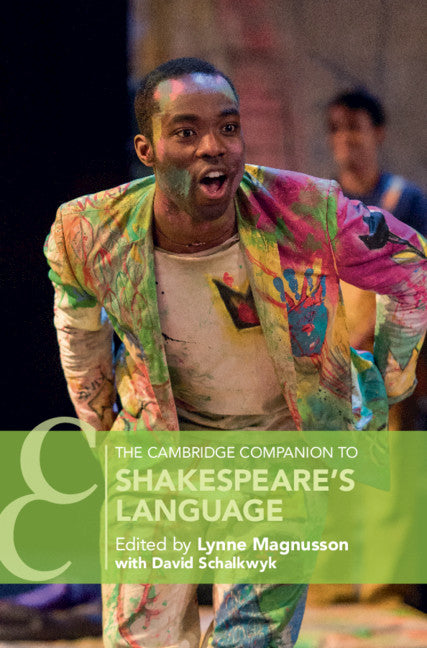
The Cambridge Companion to Shakespeare's Language
Author(s): Edited by Lynne Magnusson , David Schalkwyk
Quantity
Pickup available at Cambridge University Press Bookshop
Usually ready in 24 hours
The Cambridge Companion to Shakespeare's Language
Cambridge University Press Bookshop
1-2 Trinity Street
Cambridge CB2 1SZ
United Kingdom
🚚 Please note we can only ship within the UK.
FREE delivery on books (excluding sale).
Delivery for other items is £1.50 - £4.50, calculated at checkout.
T&Cs apply.
Free click & collect on all orders.
The power of Shakespeare's complex language - his linguistic playfulness, poetic diction and dramatic dialogue - inspires and challenges students, teachers, actors and theatre-goers across the globe. It has iconic status and enormous resonance, even as language change and the distance of time render it more opaque and difficult. The Cambridge Companion to Shakespeare's Language provides important contexts for understanding Shakespeare's experiments with language and offers accessible approaches to engaging with it directly and pleasurably. Incorporating both practical analysis and exemplary readings of Shakespearean passages, it covers elements of style, metre, speech action and dialogue; examines the shaping contexts of rhetorical education and social language; test-drives newly available digital methodologies and technologies; and considers Shakespeare's language in relation to performance, translation and popular culture. The Companion explains the present state of understanding while identifying opportunities for fresh discovery, leaving students equipped to ask productive questions and try out innovative methods.

Choose options