
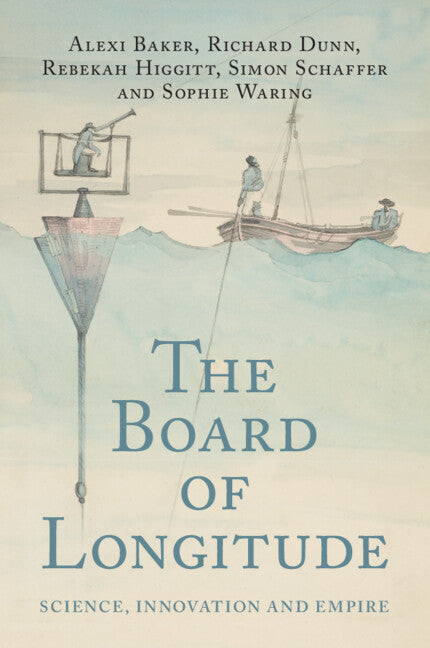
The Board of Longitude
Science, Innovation and Empire
Author(s): Alexi Baker, Richard Dunn, Rebekah Higgitt, Simon Schaffer, Sophie Waring
Quantity
Pickup available at Cambridge University Press Bookshop
Usually ready in 24 hours
The Board of Longitude
Cambridge University Press Bookshop
1-2 Trinity Street
Cambridge CB2 1SZ
United Kingdom
🚚 Please note we can only ship within the UK.
FREE delivery on books (excluding sale).
Delivery for other items is £1.50 - £4.50, calculated at checkout.
T&Cs apply.
Free click & collect on all orders.
In the first book-length history of the Board of Longitude, a distinguished team of historians of science bring to life one of Georgian Britain's most important scientific institutions. Having developed in the eighteenth century following legislation offering rewards for methods to determine longitude at sea, the Board came to support the work of navigators, instrument makers, clockmakers and surveyors, and assembled the Nautical Almanac. Utilizing the archives and records of the Board, recently digitised by the same team, the authors shed new light on the Board's involvement in colonial projects, Pacific and Arctic exploration, as well as on innovative practitioners whose work would otherwise be lost to history. This is an invaluable guide to science, state and society in Georgian Britain, a period of dramatic industrial and imperial and technological expansion.
- Guides readers through the Board of Longitude archives with authoritative and wide-ranging commentary
- Analyses the role of the state as patron during times of industrial, economic and imperial transformation
- Highlights previously unknown practitioners making key innovations

Choose options