
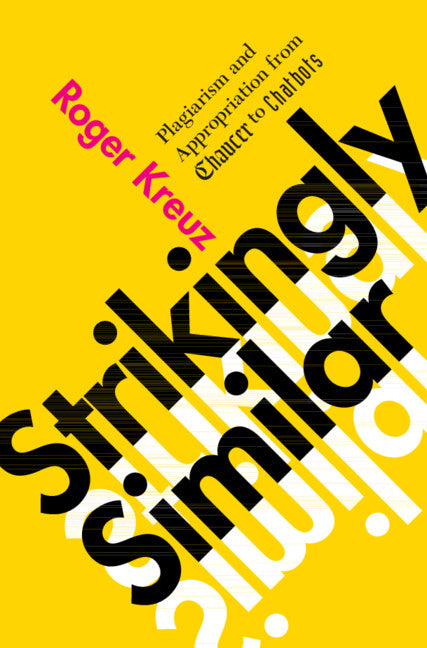
Strikingly Similar
Plagiarism and Appropriation from Chaucer to Chatbots
Author(s): Roger Kreuz
Quantity
Pickup available at Cambridge University Press Bookshop
Usually ready in 24 hours
Strikingly Similar
Cambridge University Press Bookshop
1-2 Trinity Street
Cambridge CB2 1SZ
United Kingdom
🚚 Please note we can only ship within the UK.
FREE delivery on books (excluding sale).
Delivery for other items is £1.50 - £4.50, calculated at checkout.
T&Cs apply.
Free click & collect on all orders.
Plagiarism and appropriation are hot topics when they appear in the news. A politician copies a section of a speech, a section of music sounds familiar, the plot of a novel follows the same pattern as an older story, a piece of scientific research is attributed to the wrong researcher… The list is endless. Allegations and convictions of such incidents can easily ruin a career and inspire gossip. People report worrying about unconsciously appropriating someone else's work. But why do people plagiarise? How many claims of unconscious plagiarism are truthful? How is plagiarism detected, and what are the outcomes for the perpetrators and victims? Strikingly Similar uncovers the deeper psychology behind this controversial human behavior, as well as a cultural history that is far wider and more interesting than sensationalised news stories.
- Shares a demystified look at the psychology and legality of appropriation, conscious plagiarism and unconscious plagiarism
- Provides a historical review of plagiarism and appropriation, showing how attitudes about these behaviors have shifted over time
- Highlights how plagiarism is a cultural construct that has evolved due to changing notions of intellectual propert

Choose options