
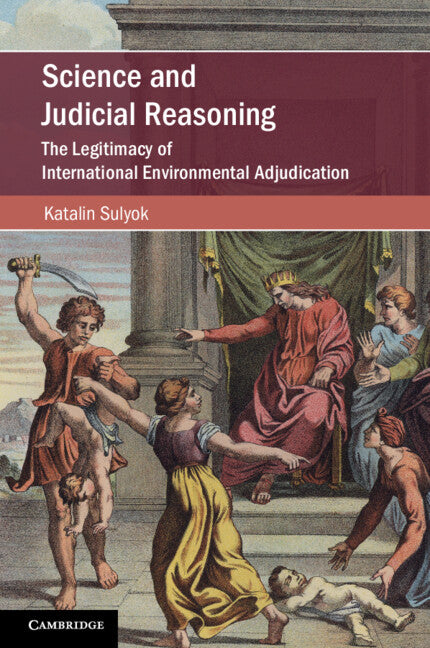
Science and Judicial Reasoning
The Legitimacy of International Environmental Adjudication
Author(s): Katalin Sulyok
Quantity
Pickup available at Cambridge University Press Bookshop
Usually ready in 24 hours
Science and Judicial Reasoning
Cambridge University Press Bookshop
1-2 Trinity Street
Cambridge CB2 1SZ
United Kingdom
🚚 Please note we can only ship within the UK.
FREE delivery on books (excluding sale).
Delivery for other items is £1.50 - £4.50, calculated at checkout.
T&Cs apply.
Free click & collect on all orders.
Science, which inevitably underlies environmental disputes, poses significant challenges for the scientifically untrained judges who decide such cases. In addition to disrupting ordinary fact-finding and causal inquiry, science can impact the framing of disputes and the standard of review. Judges must therefore adopt various tools to adjust the level of science allowed to enter their deliberations, which may fundamentally impact the legitimacy of their reasoning. While neglecting or replacing scientific authority can erode the convincing nature of judicial reasoning, the same authority, when treated properly, may lend persuasive force to adjudicatory findings, and buttress the legitimacy of judgments. In this work, Katalin Sulyok surveys the environmental case law of seven major jurisdictions and analyzes framing techniques, evidentiary procedures, causal inquiries and standards of review, offering valuable insight into how judges justify their choices between rival scientific claims in a convincing and legitimate manner.
- Builds upon interdisciplinary insights from natural science literature and the philosophy of science to explain the challenges of adjudicating science-heavy legal disputes
- Examines judicial techniques with respect to all four stages of the adjudicatory process, where judges confront scientific arguments and evidence
- Provides an in-depth analysis of environmental decisions of seven major international courts and tribunals and shows how scientific arguments and evidence are appreciated and circumvented by judges

Choose options