
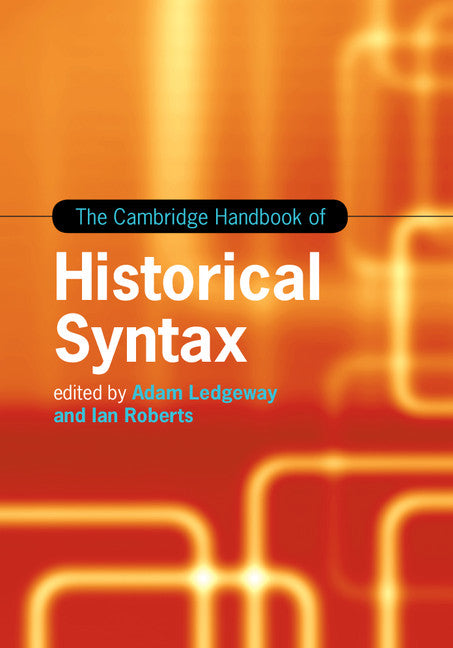
SALE The Cambridge Handbook of Historical Syntax
Author(s): Adam Ledgeway, Ian Roberts
Quantity
Pickup available at Cambridge University Press Bookshop
Usually ready in 24 hours
SALE The Cambridge Handbook of Historical Syntax
Cambridge University Press Bookshop
1-2 Trinity Street
Cambridge CB2 1SZ
United Kingdom
🚚 Please note we can only ship within the UK.
FREE delivery on books (excluding sale).
Delivery for other items is £1.50 - £4.50, calculated at checkout.
T&Cs apply.
Free click & collect on all orders.
This book is unused and unread. It has some cosmetic imperfections such as scuffing or creasing. Its dust jacket might be damaged. It might be stamped 'damaged'.
This book cannot be discounted further.
Change is an inherent feature of all aspects of language, and syntax is no exception. While the synchronic study of syntax allows us to make discoveries about the nature of syntactic structure, the study of historical syntax offers even greater possibilities. Over recent decades, the study of historical syntax has proven to be a powerful scientific tool of enquiry with which to challenge and reassess hypotheses and ideas about the nature of syntactic structure which go beyond the observed limits of the study of the synchronic syntax of individual languages or language families. In this timely Handbook, the editors bring together the best of recent international scholarship on historical syntax. Each chapter is focused on a theme rather than an individual language, allowing readers to discover how systematic descriptions of historical data can profitably inform and challenge highly diverse sets of theoretical assumptions.

Choose options