
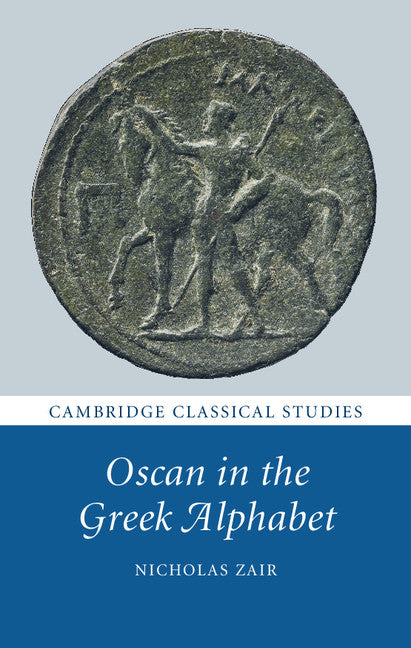
SALE Oscan in the Greek Alphabet
Author(s): Nicholas Zair
Quantity
Pickup available at Cambridge University Press Bookshop
Usually ready in 24 hours
SALE Oscan in the Greek Alphabet
Cambridge University Press Bookshop
1-2 Trinity Street
Cambridge CB2 1SZ
United Kingdom
🚚 Please note we can only ship within the UK.
FREE delivery on books (excluding sale).
Delivery for other items is £1.50 - £4.50, calculated at checkout.
T&Cs apply.
Free click & collect on all orders.
This book is unused and unread. It has some cosmetic imperfections such as scuffing, tearing and creasing. It is stamped 'damaged'. No further discounts.
Oscan was spoken in Southern Italy in the second half of the first millennium BC. Here, for the first time, all the evidence for the spelling of Oscan in the Greek alphabet is collected and examined. Understanding the orthography of these inscriptions has far-reaching implications for the historical phonology and morphology of Oscan and the Italic languages (for example providing unique evidence for the reconstruction of the genitive plural). A striking discovery is the lack of a standardised orthography for Oscan in the Greek alphabet, which seriously problematises attempts to date inscriptions by assuming the consistent chronological development of spelling features. There are also intriguing insights into the linguistic situation in South Italy. Rather than a separate community of Oscan-speakers who had adopted and subsequently adapted the Greek alphabet in isolation, we should posit groups who were in touch with contemporary developments in Greek orthography due to widespread Greek-Oscan bilingualism.

Choose options