
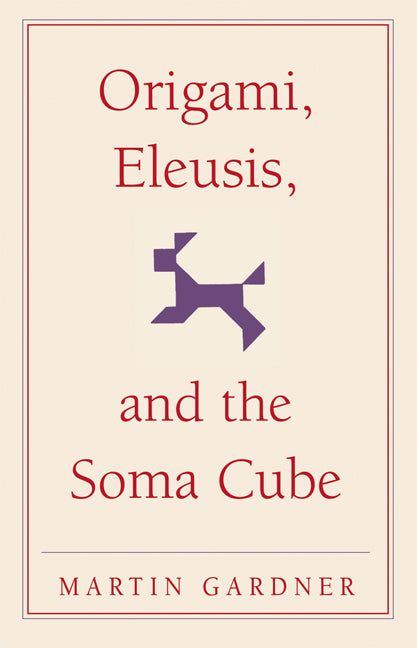
SALE Origami, Eleusis, and the Soma Cube
Martin Gardner's Mathematical Diversions
Author(s): Martin Gardner
Quantity
Pickup available at Cambridge University Press Bookshop
Usually ready in 24 hours
SALE Origami, Eleusis, and the Soma Cube
Cambridge University Press Bookshop
1-2 Trinity Street
Cambridge CB2 1SZ
United Kingdom
🚚 Please note we can only ship within the UK.
FREE delivery on books (excluding sale).
Delivery for other items is £1.50 - £4.50, calculated at checkout.
T&Cs apply.
Free click & collect on all orders.
This book is unused and unread. It has some cosmetic imperfections such as scuffing, tearing or creasing. There is a defect in the binding.
No further discounts.
Martin Gardner continues to delight. He introduces readers to the Generalized Ham Sandwich Theorem, origami, digital roots, magic squares, the mathematics of cooling coffee, the induction game of Eleusis, Dudeney puzzles, the maze at Hampton Court Palace, and many more mathematical puzzles and principles. Origami, Eleusis, and the Soma Cube is the second volume in Martin Gardner's New Mathematical Library, based on his enormously popular Scientific American columns. Now the author, in consultation with experts, has added updates to all the chapters, including new game variations, mathematical proofs, and other developments and discoveries, to challenge and fascinate a new generation of readers.
- Includes expanded/revised material for every chapter
- First time reissue of entire Martin Gardner Scientific American column run

Choose options