
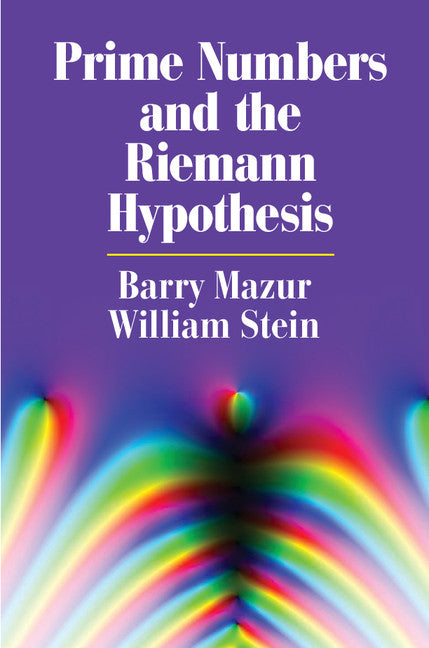
Prime Numbers and the Riemann Hypothesis
Author(s): Barry Mazur, William Stein
Quantity
Pickup available at Cambridge University Press Bookshop
Usually ready in 24 hours
Prime Numbers and the Riemann Hypothesis
Cambridge University Press Bookshop
1-2 Trinity Street
Cambridge CB2 1SZ
United Kingdom
🚚 Please note we can only ship within the UK.
FREE delivery on books (excluding sale).
Delivery for other items is £1.50 - £4.50, calculated at checkout.
T&Cs apply.
Free click & collect on all orders.
Prime numbers are beautiful, mysterious, and beguiling mathematical objects. The mathematician Bernhard Riemann made a celebrated conjecture about primes in 1859, the so-called Riemann hypothesis, which remains one of the most important unsolved problems in mathematics. Through the deep insights of the authors, this book introduces primes and explains the Riemann hypothesis. Students with a minimal mathematical background and scholars alike will enjoy this comprehensive discussion of primes. The first part of the book will inspire the curiosity of a general reader with an accessible explanation of the key ideas. The exposition of these ideas is generously illuminated by computational graphics that exhibit the key concepts and phenomena in enticing detail. Readers with more mathematical experience will then go deeper into the structure of primes and see how the Riemann hypothesis relates to Fourier analysis using the vocabulary of spectra. Readers with a strong mathematical background will be able to connect these ideas to historical formulations of the Riemann hypothesis.

Choose options