
Modelling transport and mixing by turbulence in complex flows are huge challenges for computational fluid dynamics (CFD). This highly readable book introduces readers to modelling levels that respect the physical complexity of turbulent flows. It examines the hierarchy of Reynolds-averaged Navier-Stokes (RANS) closures in various situations ranging from fundamental flows to three-dimensional industrial and environmental applications. The general second-moment closure is simplified to linear eddy-viscosity models, demonstrating how to assess the applicability of simpler schemes and the conditions under which they give satisfactory predictions. The principal changes for the second edition reflect the impact of computing power: a new chapter devoted to unsteady RANS and another on how large-eddy simulation, LES, and RANS strategies can be effectively combined for particular applications. This book will remain the standard for those in industry and academia seeking expert guidance on the modelling options available, and for graduate students in physics, applied mathematics and engineering entering the world of turbulent flow CFD.
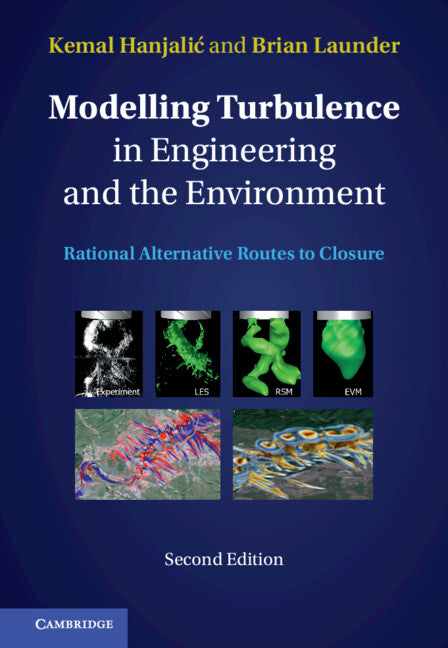
Modelling Turbulence in Engineering and the Environment
Author(s): Kemal HanjaliÔc, B. E. Launder
Quantity
Pickup available at Cambridge University Press Bookshop
Usually ready in 24 hours
Modelling Turbulence in Engineering and the Environment
Cambridge University Press Bookshop
Pickup available, Usually ready in 24 hours
1-2 Trinity Street
Cambridge CB2 1SZ
United Kingdom
🚚 Please note we can only ship within the UK.
FREE delivery on books (excluding sale).
Delivery for other items is £1.50 - £4.50, calculated at checkout.
T&Cs apply.
Free click & collect on all orders.
.%20This%20highly%20readable%20book%20introduces%20readers%20to%20modelling%20levels%20that%20...)
Choose options
Modelling Turbulence in Engineering and the Environment
Sale price£147.00 GBP