
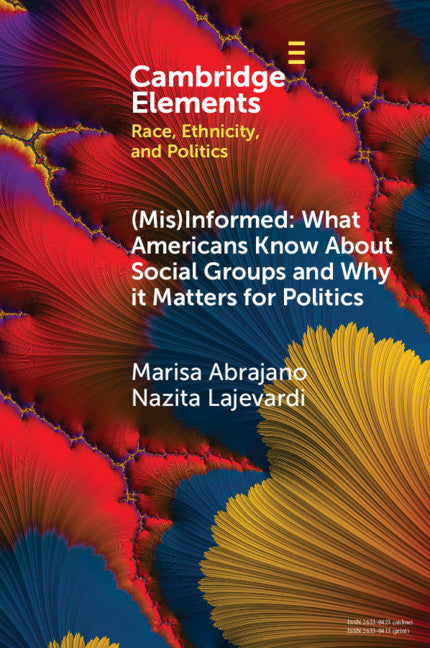
(Mis)Informed: What Americans Know About Social Groups and Why it Matters for Politics
Author(s): Marisa Abrajano , Nazita Lajevardi
Quantity
Pickup available at Cambridge University Press Bookshop
Usually ready in 24 hours
(Mis)Informed: What Americans Know About Social Groups and Why it Matters for Politics
Cambridge University Press Bookshop
1-2 Trinity Street
Cambridge CB2 1SZ
United Kingdom
🚚 Please note we can only ship within the UK.
FREE delivery on books (excluding sale).
Delivery for other items is £1.50 - £4.50, calculated at checkout.
T&Cs apply.
Free click & collect on all orders.
This Element examines just how much the public knows about some of America's most stigmatized social groups, who comprise 40.3% of the population, and evaluates whether misinformation matters for shaping policy attitudes and candidate support. The authors design and field an original survey containing large national samples of Black, Latino, Asian, Muslim, and White Americans, and include measures of misinformation designed to assess the amount of factual information that individuals possess about these groups. They find that Republicans, Whites, the most racially resentful, and consumers of conservative news outlets are the most likely to be misinformed about socially marginalized groups. Their analysis also indicates that misinformation predicts hostile policy support on racialized issues; it is also positively correlated with support for Trump. They then conducted three studies aimed at correcting misinformation. Their research speaks to the prospects of a well-functioning democracy, and its ramifications on the most marginalized.

Choose options