
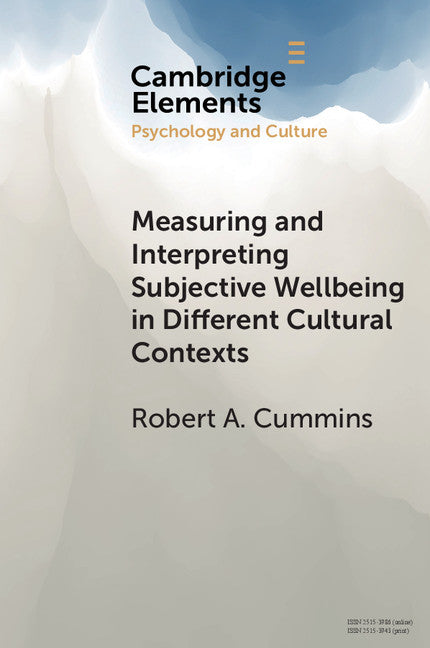
Measuring and Interpreting Subjective Wellbeing in Different Cultural Contexts
A Review and Way Forward
Author(s): Robert A. Cummins
Quantity
Pickup available at Cambridge University Press Bookshop
Usually ready in 24 hours
Measuring and Interpreting Subjective Wellbeing in Different Cultural Contexts
Cambridge University Press Bookshop
1-2 Trinity Street
Cambridge CB2 1SZ
United Kingdom
🚚 Please note we can only ship within the UK.
FREE delivery on books (excluding sale).
Delivery for other items is £1.50 - £4.50, calculated at checkout.
T&Cs apply.
Free click & collect on all orders.
The scientific study of 'wellbeing' involves both objective and subjective variables. While objective wellbeing can be simply measured as tangible aspects of the living environment, measuring subjective wellbeing involves quantifying self-reported feelings. Although reliable and valid measures can be achieved, in a cross-cultural context differences in language and culture present formidable challenges to measurement comparability. This Element begins by describing the behaviour of subjective wellbeing in single cultures, using the theory of homeostasis. Robert A. Cummins then discusses cross-cultural differences in subjective wellbeing, with a focus on measurement invariance as a means of ensuring the validity of comparative results. Cummins proposes that the major barrier to creating such comparability of measurement is a pervasive response bias that differs between cultures. He concludes that current instruments are inadequate to provide valid cross-cultural measures of subjective wellbeing, and that suitable measures may be created as short forms of current scales.

Choose options