
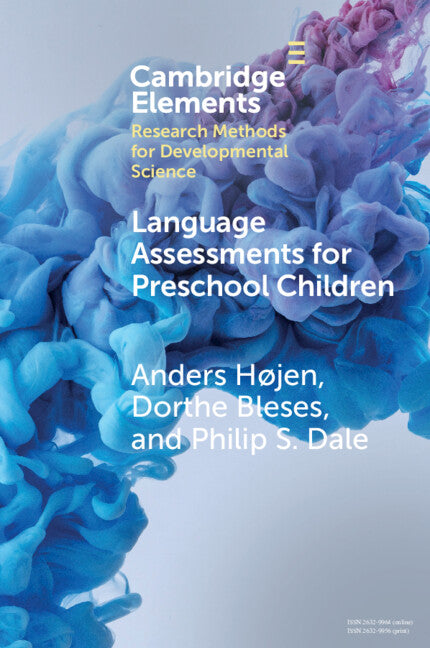
Language Assessments for Preschool Children
Validity and Reliability of Two New Instruments Administered by Childcare Educators
Author(s): Anders Højen , Dorthe Bleses , Philip S. Dale
Quantity
Pickup available at Cambridge University Press Bookshop
Usually ready in 24 hours
Language Assessments for Preschool Children
Cambridge University Press Bookshop
1-2 Trinity Street
Cambridge CB2 1SZ
United Kingdom
🚚 Please note we can only ship within the UK.
FREE delivery on books (excluding sale).
Delivery for other items is £1.50 - £4.50, calculated at checkout.
T&Cs apply.
Free click & collect on all orders.
This Element has two main purposes. Firstly, it discusses purposes, advantages, and disadvantages as well as the challenges of different formats of language assessment, concluding with a focus on educator-administered language assessment in early childhood and education programs. It addresses the selection of assessment domains, the trade-off between brevity and precision, the challenge of assessing bilinguals, and accommodating the requirements of funders (e.g., government agencies) and users (e.g., educators and schools). It draws on lessons learned from developing two instruments for a national Danish-language and preliteracy assessment program. Secondly, it introduces those two educator-administered instruments-Language Assessment 3-6 (LA 3-6) and Language Assessment 2-year-olds (LA 2)-with respect to content, norming, gender and socioeconomic influences as well as psychometric qualities. The intention is that this experience can help enable the extension of the educator-based approach to other languages and contexts, while simultaneously acknowledging that linguistic and cultural adaptations are crucial.

Choose options