
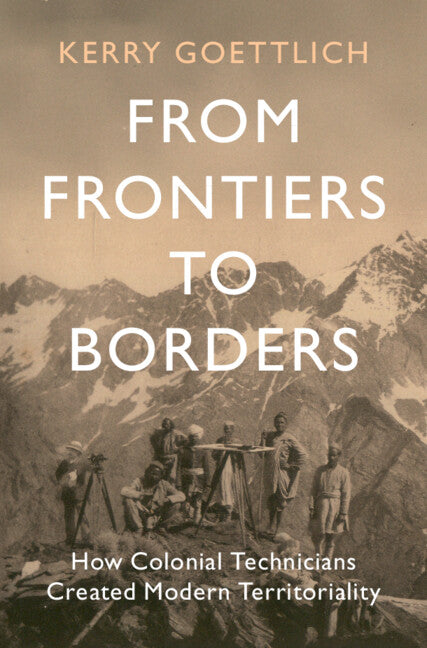
From Frontiers to Borders
How Colonial Technicians Created Modern Territoriality
Author(s): Kerry Goettlich
Quantity
Pickup available at Cambridge University Press Bookshop
Usually ready in 24 hours
From Frontiers to Borders
Cambridge University Press Bookshop
1-2 Trinity Street
Cambridge CB2 1SZ
United Kingdom
🚚 Please note we can only ship within the UK.
FREE delivery on books (excluding sale).
Delivery for other items is £1.50 - £4.50, calculated at checkout.
T&Cs apply.
Free click & collect on all orders.
How did modern territoriality emerge and what are its consequences? This book examines these key questions with a unique global perspective. Kerry Goettlich argues that linear boundaries are products of particular colonial encounters, rather than being essentially an intra-European practice artificially imposed on colonized regions. He reconceptualizes modern territoriality as a phenomenon separate from sovereignty and the state, based on expert practices of delimitation and demarcation. Its history stems from the social production of expertise oriented towards these practices. Employing both primary and secondary sources, From Frontiers to Borders examines how this expertise emerged in settler colonies in North America and in British India – cases which illuminate a range of different types of colonial rule and influence. It also explores some of the consequences of the globalization of modern territoriality, exposing the colonial origins of Boundary Studies, and the impact of boundary experts on the Paris Peace Conference of 1919–20.
- Conceptualizes and explains the emergence of linear borders, challenging traditional narratives about the modern world being a product of essentially European characteristics which were then exported via colonialism
- Takes a global perspective which advances beyond accounts focused on one part of the world, and beyond accounts that assume diffusion as a global explanation
- Engages with primary sources to find new insights beyond existing discoveries

Choose options