
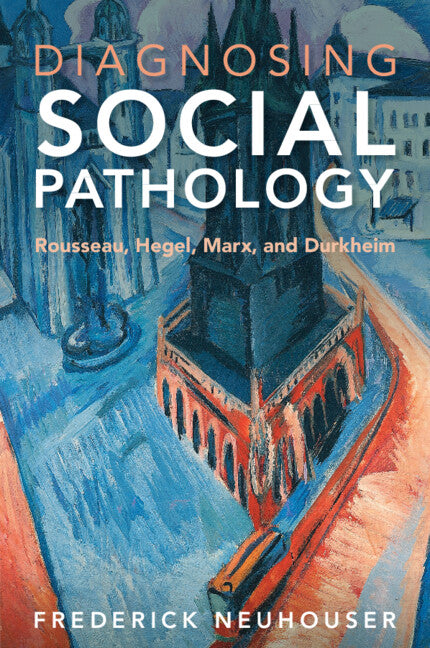
Diagnosing Social Pathology
Author(s): Frederick Neuhouser
Quantity
Pickup available at Cambridge University Press Bookshop
Usually ready in 24 hours
Diagnosing Social Pathology
Cambridge University Press Bookshop
1-2 Trinity Street
Cambridge CB2 1SZ
United Kingdom
🚚 Please note we can only ship within the UK.
FREE delivery on books (excluding sale).
Delivery for other items is £1.50 - £4.50, calculated at checkout.
T&Cs apply.
Free click & collect on all orders.
Can a human society suffer from illness like a living thing? And if so, how does such a malaise manifest itself? In this thought-provoking book, Fred Neuhouser explains and defends the idea of social pathology, demonstrating what it means to describe societies as 'ill', or 'sick', and why we are so often drawn to conceiving of social problems as ailments or maladies. He shows how Rousseau, Hegel, Marx, and Durkheim – four key philosophers who are seldom taken to constitute a 'tradition' – deploy the idea of social pathology in comparable ways, and then explores the connections between societal illnesses and the phenomena those thinkers made famous: alienation, anomie, ideology, and social dysfunction. His book is a rich and compelling illumination of both the idea of social disease and the importance it has had, and continues to have, for philosophical views of society.
- A bold and original discussion of how four key philosophers have used the idea of social pathology and how this now relates to current societal issues and problems
- Offers a robust and intriguing defence of Durkheim's social theory: which will be of much interest to philosophers, social theorists and social and political scientists alike
- In demonstrating the essential continuity between the social theories of four philosophers who are seldom taken to constitute a "tradition" (Rousseau, Hegel, Marx, and Durkheim) the book is a significant and innovative treatment of their thinking

Choose options