
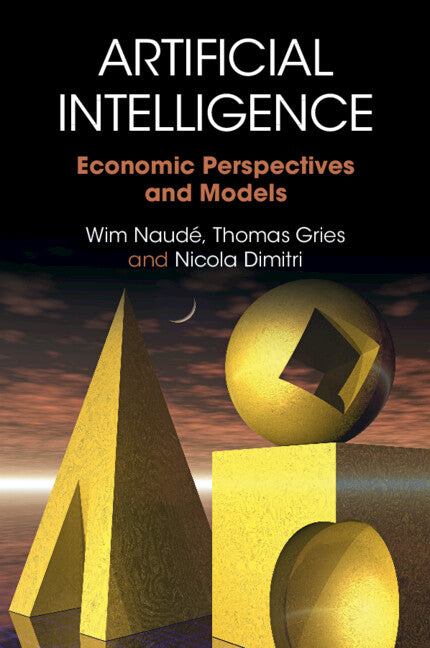
Artificial Intelligence
Economic Perspectives and Models
Author(s): Wim Naudé, Thomas Gries, Nicola Dimitri
Quantity
Pickup available at Cambridge University Press Bookshop
Usually ready in 24 hours
Artificial Intelligence
Cambridge University Press Bookshop
1-2 Trinity Street
Cambridge CB2 1SZ
United Kingdom
🚚 Please note we can only ship within the UK.
FREE delivery on books (excluding sale).
Delivery for other items is £1.50 - £4.50, calculated at checkout.
T&Cs apply.
Free click & collect on all orders.
Is Artificial Intelligence a more significant invention than electricity? Will it result in explosive economic growth and unimaginable wealth for all, or will it cause the extinction of all humans? Artificial Intelligence: Economic Perspectives and Models provides a sober analysis of these questions from an economics perspective. It argues that to better understand the impact of AI on economic outcomes, we must fundamentally change the way we think about AI in relation to models of economic growth. It describes the progress that has been made so far and offers two ways in which current modelling can be improved: firstly, to incorporate the nature of AI as providing abilities that complement and/or substitute for labour, and secondly, to consider demand-side constraints. Outlining the decision-theory basis of both AI and economics, this book shows how this, and the incorporation of AI into economic models, can provide useful tools for safe, human-centered AI.
- Explains decision-theory as the central basis which both economics and AI has in common
- Provides models to think about the immediate impacts of AI on the economy
- Provides detailed mathematical description of how AI can affect economic growth, productivity and employment

Choose options