
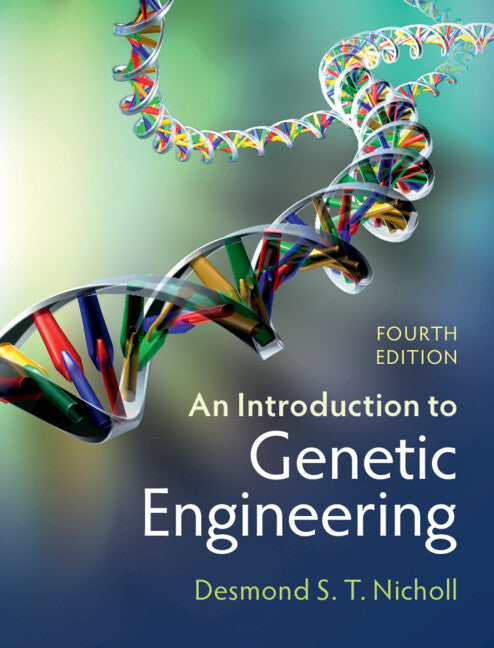
An Introduction to Genetic Engineering
4th edition
Author(s): Desmond S. T. Nicholl
Quantity
Pickup available at Cambridge University Press Bookshop
Usually ready in 24 hours
An Introduction to Genetic Engineering
Cambridge University Press Bookshop
1-2 Trinity Street
Cambridge CB2 1SZ
United Kingdom
🚚 Please note we can only ship within the UK.
FREE delivery on books (excluding sale).
Delivery for other items is £1.50 - £4.50, calculated at checkout.
T&Cs apply.
Free click & collect on all orders.
The fourth edition of this popular textbook retains its focus on the fundamental principles of gene manipulation, providing an accessible and broad-based introduction to the subject for beginning undergraduate students. It has been brought thoroughly up to date with new chapters on the story of DNA and genome editing, and new sections on bioethics, significant developments in sequencing technology and structural, functional and comparative genomics and proteomics, and the impact of transgenic plants. In addition to chapter summaries, learning objectives, concept maps, glossary and key word lists the book now also features new concluding sections, further reading lists and web-search activities for each chapter to provide a comprehensive suite of learning resources to help students develop a flexible and critical approach to the study of genetic engineering.
- A truly accessible, yet technically thorough and comprehensive, introduction to the subject
- An established and popular text, thoroughly updated to reflect the current state of the field
- Chapter summaries, aims, learning objectives, websearch tasks and concept maps combine to help students understand the topic within a sound conceptual framework
- Pedagogically rich and suitable for one or two semester courses

Choose options