
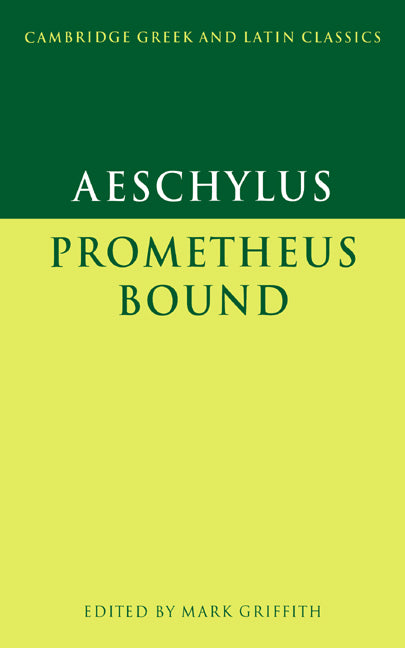
Aeschylus: Prometheus Bound
Author(s): Aeschylus , Edited by Mark Griffith
Quantity
Pickup available at Cambridge University Press Bookshop
Usually ready in 24 hours
Aeschylus: Prometheus Bound
Cambridge University Press Bookshop
1-2 Trinity Street
Cambridge CB2 1SZ
United Kingdom
🚚 Please note we can only ship within the UK.
FREE delivery on books (excluding sale).
Delivery for other items is £1.50 - £4.50, calculated at checkout.
T&Cs apply.
Free click & collect on all orders.
The myth of fire stolen from the gods appears in many pre-industrial societies. In Greek culture Prometheus the fire-stealer figures prominently in the poems of Hesiod, but in Prometheus Bound Hesiod's morality tale has been transformed into a drama of tragic tone and proportions. In the introduction, Mark Griffith examines how the dramatist has achieved this transformation, looking at the play from all angles - plot and characters, dramatic technique, style and metre. He includes a short section on the production of the play and on the questions of authenticity and date. The commentary guides the reader through problems of language, metre and content. An important feature of this volume is the appendix, which gathers together the existing fragments of the other two plays in the supposed Prometheus trilogy, quoting them in full in the original language and in translation, with short accompanying commentary. This is suitable for undergraduates and students in the upper forms of schools. It also deserves the serious attention of scholars. The introduction requires no knowledge of Greek and will interest students of drama and literature in other cultures too.

Choose options