
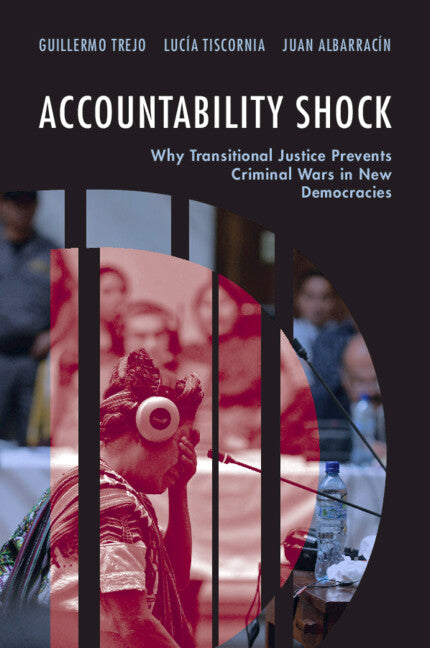
Accountability Shock
Why Transitional Justice Prevents Criminal Wars in New Democracies
Author(s): Guillermo Trejo, Lucía Tiscornia, Juan Albarracín
Quantity
Pickup available at Cambridge University Press Bookshop
Usually ready in 24 hours
Accountability Shock
Cambridge University Press Bookshop
1-2 Trinity Street
Cambridge CB2 1SZ
United Kingdom
🚚 Please note we can only ship within the UK.
FREE delivery on books (excluding sale).
Delivery for other items is £1.50 - £4.50, calculated at checkout.
T&Cs apply.
Free click & collect on all orders.
Accountability Shock presents the first systematic explanation of why some 'Third Wave' democracies developed peacefully while others became the world's most violent. The book demonstrates how robust transitional justice processes – combining truth commissions with prosecution of autocratic-era atrocities – prevent criminal violence in new democracies. By holding authoritarian specialists in violence accountable, new democracies can break state impunity, preventing them from becoming key actors in the production of large-scale criminal violence and reshaping the logic of state coercion in democracy. With in-depth analyses of six Latin American cases, the work illuminates why transitional justice is crucial for addressing state-criminal collusion in hybrid contexts. Forged out of a close collaboration between transitional justice scholars and practitioners, Accountability Shock strengthens existing connections while offering practical insights for countries still grappling with authoritarian legacies and violence.
- Develops a theory of violence prevention in new democracies through transitional justice mechanisms
- Offers robust statistical evidence and rich case studies from Brazil, El Salvador, Mexico, Argentina, Peru and Guatemala
- Shifts focus from socioeconomic explanations of violence to state-level factors

Choose options