
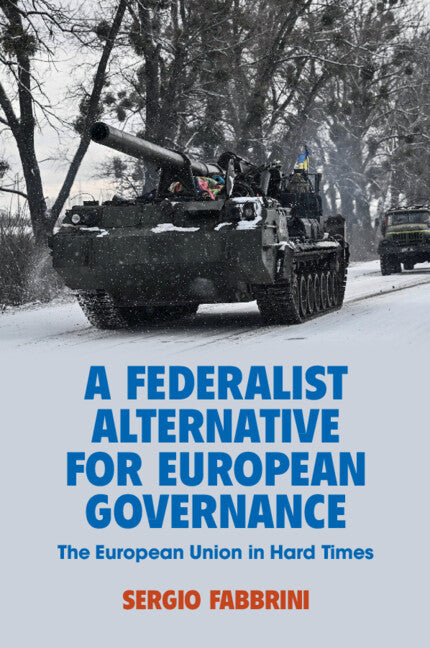
A Federalist Alternative for European Governance
The European Union in Hard Times
Author(s): Sergio Fabbrini
Quantity
Pickup available at Cambridge University Press Bookshop
Usually ready in 24 hours
A Federalist Alternative for European Governance
Cambridge University Press Bookshop
1-2 Trinity Street
Cambridge CB2 1SZ
United Kingdom
🚚 Please note we can only ship within the UK.
FREE delivery on books (excluding sale).
Delivery for other items is £1.50 - £4.50, calculated at checkout.
T&Cs apply.
Free click & collect on all orders.
How did the European Union (EU) deal with the crises of the 2010s and 2020s? These crises arose in policy realms that were the province of national governments, so the European Council was the driving institution for managing them. National governments were able to take decisions, but their decisions were contradictory and unaccountable, and regularly hindered by divisions between them. In order to manage a policymaking process dominated by the claims of national and sub-regional governments, Sergio Fabbrini argues that intergovernmental governance has had to transform the EU into an international organization. Fabbrini shows that differentiated integration would further distance the EU from the project of an 'ever closer union' and, on the basis of a comparative federalism approach, he proposes an alternative paradigm of a multi-tier Europe with a federalist core to balance national sovereignties and supranational authority.
- Investigates how the EU managed a number of different crises including sovereign debt, the COVID-19 pandemic and the energy and security crises induced by the Russia-Ukraine war
- Demonstrates how resilience in the face of crises led to a strengthening of the intergovernmental side of the EU, signalling its gradual transformation into an international organization
- Utilizes the relevant experience of federations by aggregation to formulate a federalist alternative model to the future inter-governmentalization of the EU
%20deal%20with%20the%20crises%20of%20the%202010s%20and%202020s?%20These%20crises%20arose%20in%20policy%20realms%20that%20were%20the%20province%20of%20national%20governments,%20so%20the%20European%20Council%20was%20the%20driv...)
Choose options