
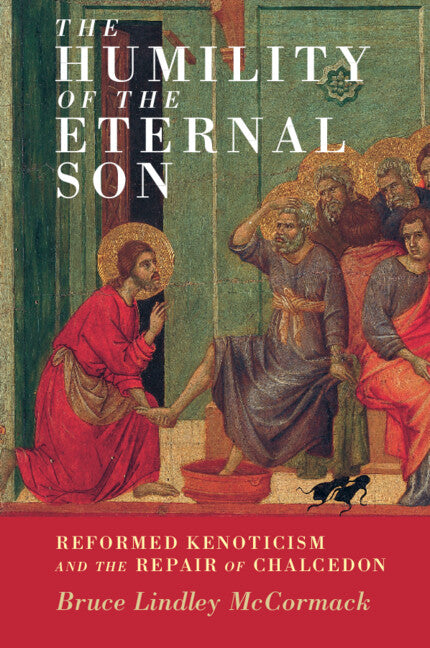
The Humility of the Eternal Son
Reformed Kenoticism and the Repair of Chalcedon
Author(s): Bruce Lindley McCormack
Quantity
Pickup available at Cambridge University Press Bookshop
Usually ready in 24 hours
The Humility of the Eternal Son
Cambridge University Press Bookshop
1-2 Trinity Street
Cambridge CB2 1SZ
United Kingdom
🚚 Please note we can only ship within the UK.
FREE delivery on books (excluding sale).
Delivery for other items is £1.50 - £4.50, calculated at checkout.
T&Cs apply.
Free click & collect on all orders.
The Chalcedonian Definition of 451 never completely resolved one of the critical issues at the heart of Christianity: the unity of the 'person' of Christ. In this eagerly-awaited volume - the result of deep and sustained reflection - distinguished theologian Bruce Lindley McCormack examines the reasons for this philosophical and theological failure. His book serves as a critical history that traces modern attempts at resolution of this problem, from the nineteenth-century Lutheran emphasis on Kenoticism (or the 'self-emptying' of the Son in order to be receptive to the will of the Father) to post-Barthian efforts that evade the issue by collapsing the second person of the Trinity into the human Jesus - thereby rejecting altogether the logic of the classical 'two-natures' Christology. McCormack shows how New Testament Christologies both limit and authorize ontological reflection, and in so doing offers a distinctively Reformed version of Kenoticism. Proposing a new and bold divine ontology, with a convincing basis in Christology, he persuasively argues that the unity of the 'person' is in fact guaranteed by the Son's act of taking into his 'being' the lived existence of Jesus.
- Offers a reformed version of Kenoticism
- Demonstrates the importance of ecclesial setting in earlier articulations of kenotic theory and demonstrates the ecumenical significance of the constructive model set forth
- Provides a basis in Christology for a new divine ontology

Choose options