
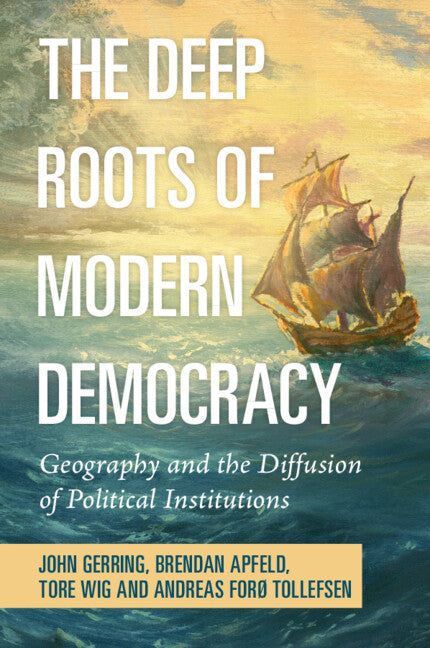
The Deep Roots of Modern Democracy
Geography and the Diffusion of Political Institutions
Author(s): John Gerring, Brendan Apfeld, Tore Wig, Andreas Forø Tollefsen
Quantity
Pickup available at Cambridge University Press Bookshop
Usually ready in 24 hours
The Deep Roots of Modern Democracy
Cambridge University Press Bookshop
1-2 Trinity Street
Cambridge CB2 1SZ
United Kingdom
🚚 Please note we can only ship within the UK.
FREE delivery on books (excluding sale).
Delivery for other items is £1.50 - £4.50, calculated at checkout.
T&Cs apply.
Free click & collect on all orders.
This book explores the deep roots of modern democracy, focusing on geography and long-term patterns of global diffusion. Its geographic argument centers on access to the sea, afforded by natural harbors which enhance the mobility of people, goods, capital, and ideas. The extraordinary connectivity of harbor regions thereby affected economic development, the structure of the military, statebuilding, and openness to the world – and, through these pathways, the development of representative democracy. The authors' second argument focuses on the global diffusion of representative democracy. Beginning around 1500, Europeans started to populate distant places abroad. Where Europeans were numerous they established some form of representative democracy, often with restrictions limiting suffrage to those of European heritage. Where they were in the minority, Europeans were more reticent about popular rule and often actively resisted democratization. Where Europeans were entirely absent, the concept of representative democracy was unfamiliar and its practice undeveloped.
- Combines in-depth case history with cross-national statistical analysis
- Tests alternate explanations alongside the authors' own
- Shows how the legacies of these deep roots exist today

Choose options