
The Capitalist Self
The Social Origins of Financial Capitalism in Early Modern England
Author(s): Craig Muldrew
Quantity
Pickup available at Cambridge University Press Bookshop
Usually ready in 24 hours
The Capitalist Self
Cambridge University Press Bookshop
1-2 Trinity Street
Cambridge CB2 1SZ
United Kingdom
🚚 Please note we can only ship within the UK.
FREE delivery on books (excluding sale).
Delivery for other items is £1.50 - £4.50, calculated at checkout.
T&Cs apply.
Free click & collect on all orders.
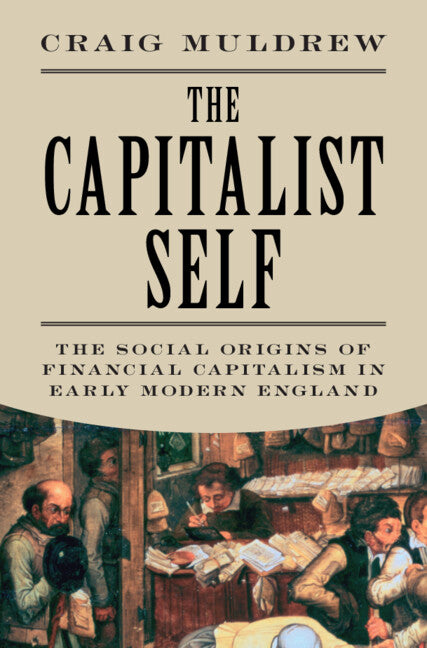
In this radical reinterpretation of the Financial Revolution, Craig Muldrew redefines our understanding of capitalism as a socially constructed set of institutions and beliefs. Financial institutions, including the Bank of England and the stock market, were just one piece of the puzzle. Alongside institutional developments, changes in local credit networks involving better accounting, paper notes and increased mortgaging were even more important. Muldrew argues that, before a society can become capitalist, most of its members have to have some engagement with 'capital' as a thing – a form of stored intangible financial value. He shows how previous oral interpersonal credit was transformed into capital through the use of accounting and circulating paper currency, socially supported by changing ideas about the self which stressed individual savings and responsibility. It was only through changes throughout society that the framework for a concept like capitalism could exist and make sense.
- Provides an empirically grounded explanation for capital as a tangible thing, rather than a nebulous concept
- Reinterprets the Financial Revolution arguing for the significance of local credit networks alongside larger institutions
- Highlights the importance of the early modern self through its relation to economic practice

Choose options