
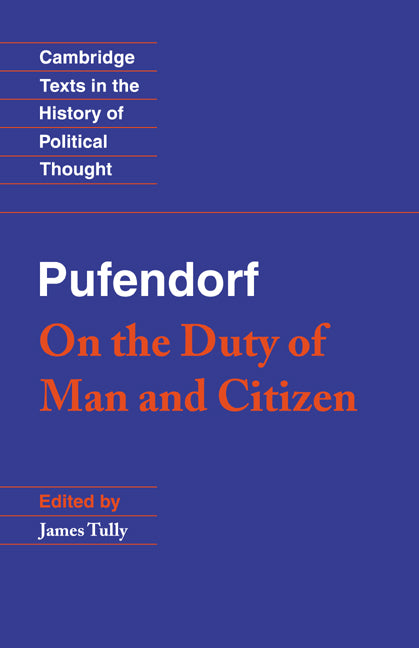
Pufendorf: On the Duty of Man and Citizen according to Natural Law
Author(s): Samuel Pufendorf, Edited by James Tully, Translated by Michael Silverthorne
Quantity
Pickup available at Cambridge University Press Bookshop
Usually ready in 24 hours
Pufendorf: On the Duty of Man and Citizen according to Natural Law
Cambridge University Press Bookshop
1-2 Trinity Street
Cambridge CB2 1SZ
United Kingdom
🚚 Please note we can only ship within the UK.
FREE delivery on books (excluding sale).
Delivery for other items is £1.50 - £4.50, calculated at checkout.
T&Cs apply.
Free click & collect on all orders.
On the Duty of Man and Citizen (1673) is Pufendorf's succinct and condensed presentation of the natural law political theory he developed in his monumental classic On the Law of Nature and Nations (1672). His theory was the most influential natural law philosophy of the seventeenth- and eighteenth-centuries. He advanced a compelling reply to Grotius and Hobbes, and in doing so, set the intellectual problems for theorists such as Locke, Hutcheson, Hume, Rousseau, and Smith. In the aftermath of the Thirty Years' War, Pufendorf sets forth a classic justification of the early modern enlightened state and of the proper relations of moral and political subjection to it. This lucid and historically sensitive translation by Michael Silverthorne, (a classicist and a specialist in Roman Law and early modern political thought) is the first since the early twentieth century. James Tully's introduction sets the text in its seventeenth-century context, summarises the main arguments, surveys recent literature on Pufendorf, and shows how Pufendorf transformed natural law theory into an independent discipline of juristic political philosophy which dominated reflection on politics until Kant.
%20is%20Pufendorf's%20succinct%20and%20condensed%20presentation%20of%20the%20natural%20law%20political%20theory%20he%20developed%20in%20his%20monumental%20classic%20On%20the%20Law%20of%20Nature%20and%20Nations%20...)
Choose options