
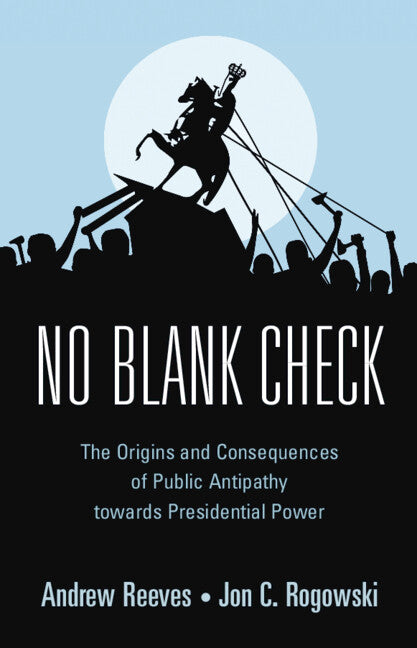
No Blank Check
The Origins and Consequences of Public Antipathy towards Presidential Power
Author(s): Andrew Reeves , Jon C. Rogowski
Quantity
Pickup available at Cambridge University Press Bookshop
Usually ready in 24 hours
No Blank Check
Cambridge University Press Bookshop
1-2 Trinity Street
Cambridge CB2 1SZ
United Kingdom
🚚 Please note we can only ship within the UK.
FREE delivery on books (excluding sale).
Delivery for other items is £1.50 - £4.50, calculated at checkout.
T&Cs apply.
Free click & collect on all orders.
Concerns about unaccountable executive power have featured recurrently in political debates from the American founding to today. For many, presidents' use of unilateral power threatens American democracy. No Blank Check advances a new perspective: Instead of finding Americans apathetic towards how presidents exercise power, it shows the public is deeply concerned with core democratic values. Drawing on data from original surveys, innovative experiments, historical polls, and contexts outside the United States, the book highlights Americans' skepticism towards presidential power. This skepticism results in a public that punishes unilaterally minded presidents and the policies they pursue. By departing from existing theories of presidential power which acknowledge only institutional constraints, this timely and revealing book demonstrates the public's capacity to tame the unilateral impulses of even the most ambitious presidents. Ultimately, when it comes to exercising power, the public does not hand the president a blank check.
- Develops a theory of the origins of attitudes toward presidential power
- Improves institutional understanding of the presidency and separation of powers
- Demonstrates the importance of public opinion for presidential politics

Choose options