
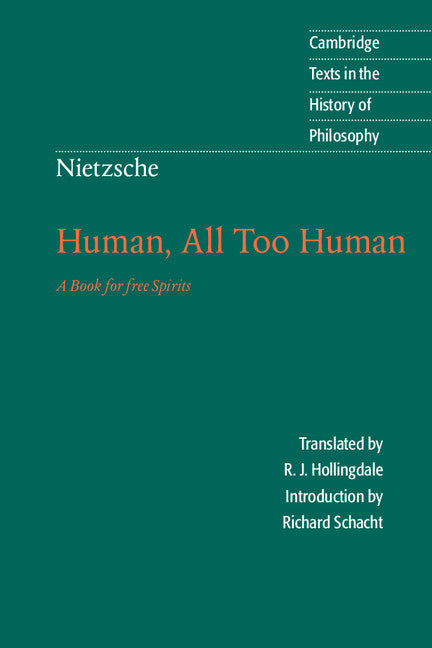
Nietzsche: Human, All Too Human
A Book for Free Spirits
Author(s): Friedrich Nietzsche, Edited by R. J. Hollingdale, Introduction by Richard Schacht
Quantity
Pickup available at Cambridge University Press Bookshop
Usually ready in 24 hours
Nietzsche: Human, All Too Human
Cambridge University Press Bookshop
1-2 Trinity Street
Cambridge CB2 1SZ
United Kingdom
🚚 Please note we can only ship within the UK.
FREE delivery on books (excluding sale).
Delivery for other items is £1.50 - £4.50, calculated at checkout.
T&Cs apply.
Free click & collect on all orders.
This remarkable collection of almost 1,400 aphorisms was originally published in three instalments. The first (now Volume I) appeared in 1878, just before Nietzsche abandoned academic life, with a first supplement entitled The Assorted Opinions and Maxims following in 1879, and a second entitled The Wanderer and his Shadow a year later. In 1886 Nietzsche republished them together in a two-volume edition, with new prefaces to each volume. Both volumes are presented here in R. J. Hollingdale's distinguished translation (originally published in the series Cambridge Texts in German Philosophy) with a new introduction by Richard Schacht. In this wide-ranging work Nietzsche first employed his celebrated aphoristic style, so perfectly suited to his iconoclastic, penetrating and multi-faceted thought. Many themes of his later work make their initial appearance here, expressed with unforgettable liveliness and subtlety. Human, All Too Human well deserves its subtitle 'A Book for Free Spirits', and its original dedication to Voltaire, whose project of radical enlightenment here found a new champion.
%20appeared%20in%201878,%20just%20before%20Nietzsche%20abandoned%20academic%20life,%20with%20a%20...)
Choose options