
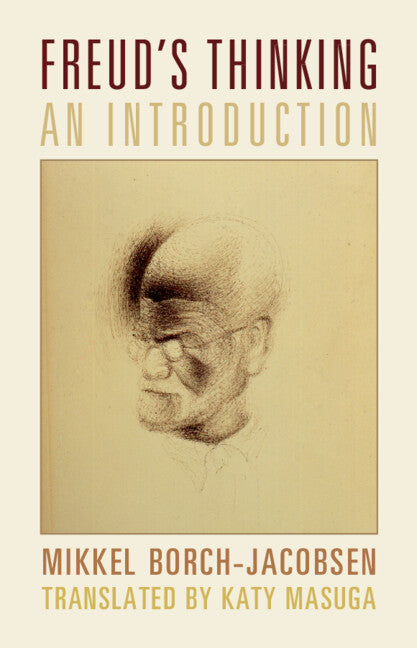
Freud's Thinking: An Introduction
Author(s): Mikkel Borch-Jacobsen, Translated by Katy Masuga
Quantity
Pickup available at Cambridge University Press Bookshop
Usually ready in 24 hours
Freud's Thinking: An Introduction
Cambridge University Press Bookshop
1-2 Trinity Street
Cambridge CB2 1SZ
United Kingdom
🚚 Please note we can only ship within the UK.
FREE delivery on books (excluding sale).
Delivery for other items is £1.50 - £4.50, calculated at checkout.
T&Cs apply.
Free click & collect on all orders.
In this brief but comprehensive introduction to Freud's theories, Mikkel Borch-Jacobsen provides a step-by-step overview of his ideas regarding the unconscious, the cure, sexuality, drives, and culture, highlighting their indebtedness to contemporary neurophysiological and biological assumptions. The picture of Freud that emerges is very different from that of the fact-finding scientist he claimed to be. Bold conceptual innovations - repression, infantile sexuality, the Oedipus complex, narcissism, the death drive - were not discoveries made by Freud, but speculative constructs placed on clinical material to satisfy the requirements of the general theory of the mind and culture that he was building. Freud's Thinking provides a final accounting of this mirage of the mind that was psychoanalysis.
- Introduces Freud's theory step by step using ordinary-language arguments throughout, making it accessible to readers without specialized training
- Uses a history of ideas approach that places Freud's psychoanalysis in the larger context of then-current scientific theories
- Allows the reader to understand that Freud's conceptual innovations were not, as he claimed, fact-based but theory-driven

Choose options