
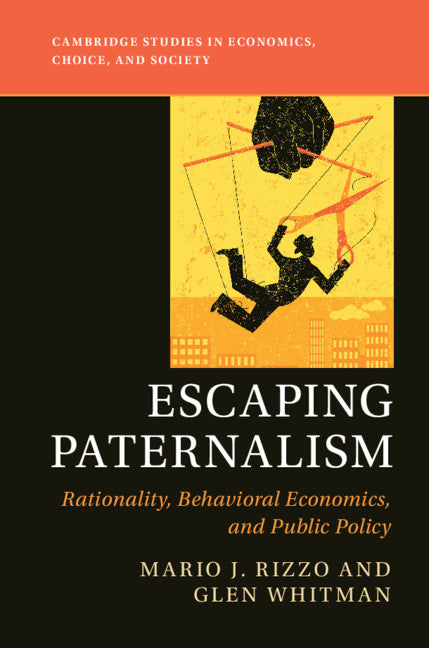
Escaping Paternalism
Rationality, Behavioral Economics, and Public Policy
Author(s): Mario J. Rizzo, Glen Whitman
Quantity
Pickup available at Cambridge University Press Bookshop
Usually ready in 24 hours
Escaping Paternalism
Cambridge University Press Bookshop
1-2 Trinity Street
Cambridge CB2 1SZ
United Kingdom
🚚 Please note we can only ship within the UK.
FREE delivery on books (excluding sale).
Delivery for other items is £1.50 - £4.50, calculated at checkout.
T&Cs apply.
Free click & collect on all orders.
The burgeoning field of behavioral economics has produced a new set of justifications for paternalism. This book challenges behavioral paternalism on multiple levels, from the abstract and conceptual to the pragmatic and applied. Behavioral paternalism relies on a needlessly restrictive definition of rational behavior. It neglects nonstandard preferences, experimentation, and self-discovery. It relies on behavioral research that is often incomplete and unreliable. It demands a level of knowledge from policymakers that they cannot reasonably obtain. It assumes a political process largely immune to the effects of ignorance, irrationality, and the influence of special interests and moralists. Overall, behavioral paternalism underestimates the capacity of people to solve their own problems, while overestimating the ability of experts and policymakers to design beneficial interventions. The authors argue instead for a more inclusive theory of rationality in economic policymaking.
- Offers a thorough analysis of the normative basis of standard economic rationality
- Provides a reassessment of the empirical evidence of cognitive biases
- Evaluates the policy proposals of behavioral economics

Choose options