
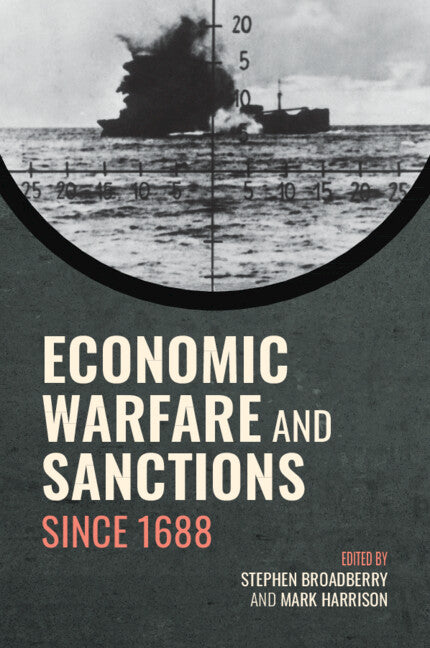
Economic Warfare and Sanctions Since 1688
Author(s): Stephen Broadberry, Mark Harrison
Quantity
Pickup available at Cambridge University Press Bookshop
Usually ready in 24 hours
Economic Warfare and Sanctions Since 1688
Cambridge University Press Bookshop
1-2 Trinity Street
Cambridge CB2 1SZ
United Kingdom
🚚 Please note we can only ship within the UK.
FREE delivery on books (excluding sale).
Delivery for other items is £1.50 - £4.50, calculated at checkout.
T&Cs apply.
Free click & collect on all orders.
How have economic warfare and sanctions been applied in modern history, with what success and with what unintended consequences? In this book, leading economic historians provide answers through case studies ranging from the eighteenth-century rivalry of Britain and France and the American Civil War to the two world wars and the Cold War. They show how countries faced with economic measures have responded by resisting, adapting to, or seeking to pre-empt the attack so that the effects of an economic attack could be delayed or temporarily neutralised. Behind the scenes, however, economic measures shaped the course of warfare: they moulded war plans, raised the adversary's costs of mobilisation, and tipped the balance of final outcomes. This book is the first to combine the study of economic warfare and sanctions, showing the deep similarities and continuities as well as the differences, in an integrated framework.
- Creates an integrated analytical framework for understanding the differences and deep continuities between peacetime sanctions and economic warfare
- Provides eight detailed case studies ranging from the Nine Years' War to the Cold War
- Highlights the wide variety of effects and responses, explaining why so many predictions failed

Choose options