
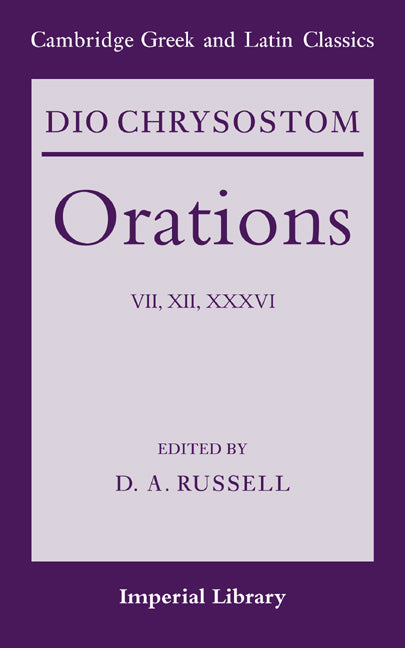
Dio Chrysostom Orations: 7, 12 and 36
Author(s): Dio Chrysostom , Edited by D. A. Russell
Quantity
Pickup available at Cambridge University Press Bookshop
Usually ready in 24 hours
Dio Chrysostom Orations: 7, 12 and 36
Cambridge University Press Bookshop
1-2 Trinity Street
Cambridge CB2 1SZ
United Kingdom
🚚 Please note we can only ship within the UK.
FREE delivery on books (excluding sale).
Delivery for other items is £1.50 - £4.50, calculated at checkout.
T&Cs apply.
Free click & collect on all orders.
Dio of Prusa, known as Dio Chrysostom, was the foremost orator in the classical world in the first century AD. This new edition, with introduction and commentary, presents three of his speeches, all of which are masterpieces of the genre and are particularly important for the intellectual history of the period. In 'Euboicus' (7), Dio relates his shipwreck in Euboea and hospitable reception by an isolated group of hunters in the mountains, and uses this as the basis of an eloquent discourse on the simple life and the evils of urban societies. In 'Olympicus' (12), he addresses the assembled crowd at Olympia on theological themes suggested by the vast statue of Zeus by Phidias, one of the wonders of the ancient world. In 'Borystheniticus' (36), he recounts a lecture he gives to the people of Olbia, a remote Greek city in southern Russia, on the subject of the true 'city' and the 'heavenly city' which is the cosmos, whose periodical destruction and rebirth he describes in a colourful orientalizing myth. This is the first commentary in English on these speeches, and while it discusses textual and linguistic problems necessary for the understanding of Dio's text, its main thrust is to make Dio more accessible to students through an appreciation of the literary qualities of his orations and the context in which they were delivered.

Choose options