
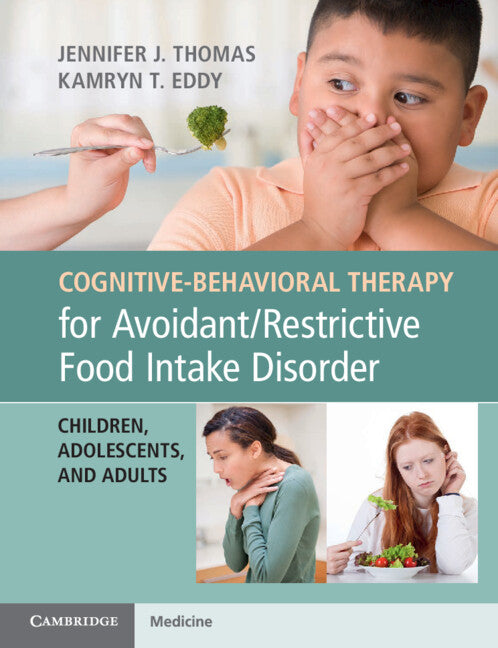
Cognitive-Behavioral Therapy for Avoidant/Restrictive Food Intake Disorder
Author(s): Jennifer J. Thomas, Kamryn T. Eddy
Quantity
Pickup available at Cambridge University Press Bookshop
Usually ready in 24 hours
Cognitive-Behavioral Therapy for Avoidant/Restrictive Food Intake Disorder
Cambridge University Press Bookshop
1-2 Trinity Street
Cambridge CB2 1SZ
United Kingdom
🚚 Please note we can only ship within the UK.
FREE delivery on books (excluding sale).
Delivery for other items is £1.50 - £4.50, calculated at checkout.
T&Cs apply.
Free click & collect on all orders.
Avoidant/restrictive food intake disorder (ARFID) is a common eating disorder diagnosis that describes children and adults who cannot meet their nutritional needs, typically because of sensory sensitivity, fear of adverse consequences and/or apparent lack of interest in eating or food. This book is the first of its kind to offer a specialist treatment, specifically for ARFID. Developed, refined and studied in response to this urgent clinical need, this book outlines a specialiZed cognitive-behavioral treatment: Cognitive-Behavioral Therapy for Avoidant/Restrictive Food Intake Disorder (CBT-AR). This treatment is designed for patients across all age groups, supported by real-life case examples and tools to allow clinicians to apply this new treatment in their own clinical settings.
- Fills a desperate gap in the market for a specialist treatment for avoidant/restrictive food intake disorder (ARFID), providing mental health professionals with information and guidance in how to treat patients
- This treatment can be offered to all age groups and therefore there is no need to learn multiple therapies
- A comprehensive therapy that addresses diagnostic heterogeneity within ARFID; clinicians can select specific modules that are relevant to the patient's primary ARFID maintaining mechanisms
%20is%20a%20common%20eating%20disorder%20diagnosis%20that%20describes%20children%20and%20adults%20who%20cannot%20meet%20their%20nutritional%20needs,%20typically%20because%20of%20sensory%20sens...)
Choose options